
Introduction To Continuous Learning in Graphic Design
Graphic design does not sit down. Styles change, tools are developed, and new ideas emerge nearly every day. What was successful a couple of years back might no longer be relevant. That is why in this field, learning never stops.
Designers who stop learning usually lag. Their work will become outdated, and they will find it difficult to meet current requirements. Conversely, designers who keep evolving remain fresh, creative and competitive.
This article will teach you ways to update your knowledge. You will learn how to develop yourself, embrace change, and build a powerful design career in the long run.
Precise Knowledge: The Need to Stay Updated
The design industry is very competitive. New designers enter the scene every year, and experienced professionals continue refining the art. To be different, you have to keep evolving.
There is also a change in client expectations. The businesses are now requiring faster output, improved images, and designs that are multimedia compatible. Simultaneously, new tools and technologies transform the work of designers.
Flexibility becomes necessary. By maintaining an open mind to change, you will be able to approach new challenges with confidence and keep producing good results.
Subscribing to Design Trends and Industry Updates
Trends in design provide insight into what is contemporary and applicable. They indicate people’s reactions to the visuals at a particular time. Trends keep you in touch with the latest fashion.
But a tendency to imitate without knowing what will debase your work. Rather, put attention on the reasons why a trend works. Research its influence on user experience and interaction.
Balance matters. Blend traditional design with contemporary elements. This will make your work feel fresh while still keeping it clear and focused.
Getting to know New Design Tools and Software
Design tools keep on developing. New features are added as updates, enhancing speed and creativity. Maintaining proficiency in programs such as Adobe Photoshop, Adobe Illustrator, and Figma can make you more effective.
Also, trying out new tools broadens your possibilities. Other tools make workflows easier, and some introduce innovative design practices. Proving them allows you the latitude.
Tool versatility matters. With knowledge of various tools, you will be able to select the most appropriate tool for each project rather than making a single tool fit all.
Enhancing Core Design Fundamentals
Trends can come and go. However, the foundations of design are here to stay. The basis of any good design is colour, typography and layout.
Going over these fundamentals makes you a more competent elementary school teacher. It helps you make more sound decisions and draw clearer images. Good fundamentals also enhance your capacity to solve design problems.
When you work with fundamentals, your work remains effective even as styles change.
Completing Online Courses and Tutorials
Organised learning can accelerate your development. Online courses will take you through the process step by step, from the foundational level to the techniques level.
Several channels offer lessons at any skill level. You will be able to select topics that suit your objectives and study at your own pace.
It is good to have clear learning objectives that keep you focused. You do not switch subjects. Instead, you build knowledge progressively and purposefully.
Learning the Work of Other Designer
You can learn a lot by observing other designers. Examine how professionals apply colour, space and composition. Note their problem-solving process.
Examine real-world projects of agencies and experienced designers. These illustrations demonstrate the application of design to real-life scenarios.
Be inspired, not imitate. Apply what you study to form your own style. With time, this activity hones your design eye.
Using Personal Projects as Practice
The best way to improve is through practice. You can do personal projects without any pressure.
Design fake work, such as posters, logos, or web layouts. Try new styles and ideas. These projects support your quest to become more creative.
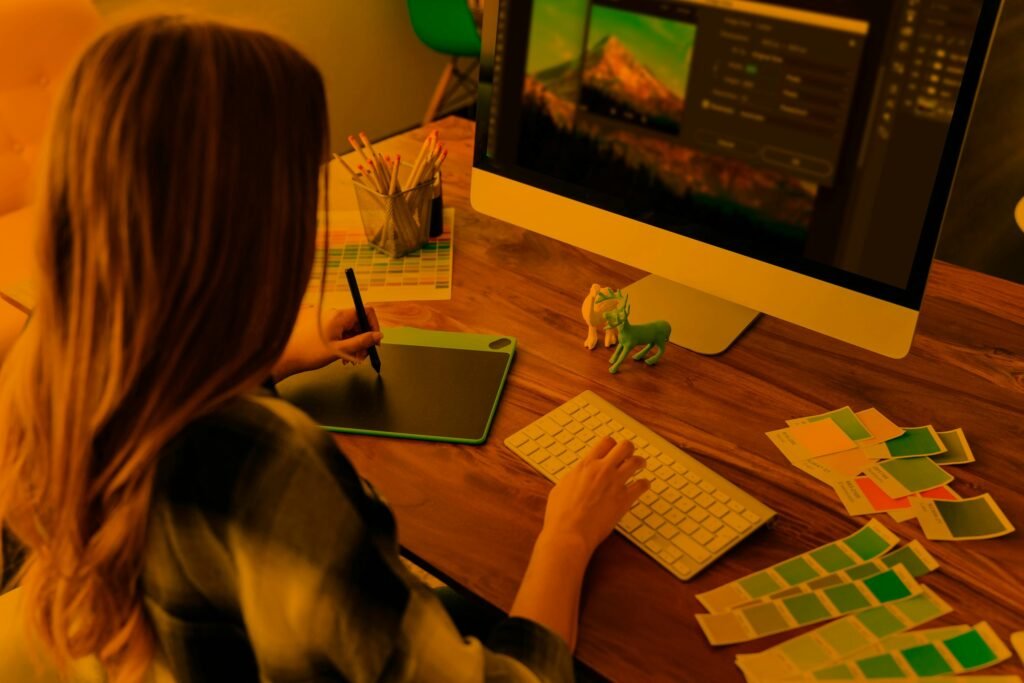
The more you practice, the more confident you become. You are quicker, more accurate, and more familiar with your tools.
Getting Feedback and Critique
Feedback makes you look at your work in another light. It throws light on things you would have ignored.
When you share your work with others, you can get constructive criticism. This feedback helps you refine your designs.
Iteration plays a key role. It makes your work more powerful with every version you apply feedback and implement changes.
Becoming a Design Community Member and Networker
Design communities provide learning and support. They introduce you to other designers to exchange ideas and experiences.
Social networks such as Behance and Dribbble help to share work and search through other projects. LinkedIn assists in establishing professional relations.
Networking opens doors. It will result in partnerships, employment, and tips on commendable advice from skilled designers.
Design Books and Resources: Reading
The books and articles offer more in-depth knowledge. They describe the design theory, history and strategy in an organised manner.
When you read about typography, branding and user experience, you broaden your horizons. The blogs and newsletters also update you on what is going on.
The habit develops a solid knowledge base that can enable your practical skills.
Going to Workshops and Events
Hands-on learning can be achieved through workshops and events. They reveal insights into the real world and the techniques used.
You can learn with experts using design conferences and webinars. You may observe how professionals work and solve problems.
Networking is also offered during such events. New ideas and connections can be inspired by meeting other designers.
Remaining Technologically Moving and AI
Design is still being influenced by technology. Many creative processes are now being influenced by artificial intelligence.
Examples of tasks that can be supported by AI include content creation, layout recommendations, and image generation. It is possible to learn to use these tools to enhance efficiency.
But balance is still significant. Great design is still characterised by creativity and human judgment. Technology is meant to be used as an aid and not a substitute.
Building A Learning Routine
Continuity leads to improvement. It is advisable to set a daily or weekly learning schedule so that you are not in the dark.
Even brief sessions can help. By taking time regularly to learn, you stay up to date with your skills.
It also helps to track your progress. It reminds you of how far you have gone, and it keeps you motivated.
Avoiding the Most Famous Learning Fallacies
Most designers attempt to know it all at once. This style is usually confusing. Focus on one skill at a time.
The other error is concentrating on tools. Tools do not make powerful work on their own without knowing design concepts.
Poor practice also retards development. Applying knowledge to learn restricts progress. Not responding to feedback can also prevent improvement.
Putting the Knowledge into Real Work
When you apply what you learn, it is useful. Apply new skills to real-world projects (personal or professional).
Revise your portfolio on schedule. Present your recent projects and emphasise your improvement. That shows you can change and improve.
Knowledge can also be applied to enhance the quality of your client work. It helps you achieve higher performance and gain trust.
Conclusion
Graphic design is a lifelong learning process. Trends shift, tools change, and new problems arise. Curious and flexible designers keep on developing.
It is wise to follow the trend, strengthen fundamentals, practice, and learn from others so you can build a strong foundation for long-term success.
Stay consistent. Keep exploring. Each additional skill becomes a value to your work. In the long run, this consistent practice changes your skills and makes you shine in the design world.